When sourcing whole dried insects for commercial feed and pet food applications, buyers often need to determine how much broken material is acceptable within a shipment. Product integrity can influence appearance, handling, packaging performance, and consistency, but a product described as “whole dried” does not necessarily mean every individual insect will remain completely intact.
The practical challenge is to distinguish normal handling-related breakage from material that fails an agreed specification. This guide explains how commercial buyers can evaluate whole and broken insects, establish measurable acceptance criteria, and review the evidence needed before confirming a bulk order.
1. What Counts as Whole or Broken Dried Insects?
Whole dried insects are dried products supplied in their recognizable insect form rather than intentionally ground or milled into powder. Depending on the species and processing method, the finished product may contain intact insects alongside a limited amount of naturally broken material.
Broken insects generally refer to specimens that have lost part of their original structure during drying, sorting, packaging, storage, or transportation. However, there is no single universal definition that applies equally to dried mealworms, crickets, grasshoppers, black soldier fly larvae (BSFL), earthworms, and other insect species.
For example, a buyer purchasing dried crickets may distinguish fully intact specimens from insects with detached legs or antennae. A buyer purchasing dried mealworms may instead focus on separated body segments, visibly fractured larvae, and accumulated fragments. These differences make species-specific inspection criteria more useful than a generic statement such as “minimal breakage.”
The key is to define which conditions count as acceptable whole material, which count as broken material, and whether fine fragments are evaluated separately. These definitions should be agreed before production or shipment rather than interpreted after delivery.
2. Why Product Integrity Matters for Commercial Buyers
Product integrity is particularly important when dried insects remain visible in the finished application. Bird food, reptile food, specialty pet products, and certain commercial feed products may have different expectations regarding the appearance and handling characteristics of whole insects. Buyers comparing species and product forms can review the available whole dried insect product range before establishing their physical-integrity requirements.
A higher proportion of broken material can affect visual consistency and may change how a product moves through packaging, dispensing, or downstream handling equipment. However, broken pieces are not automatically unsafe or nutritionally inferior. Their commercial acceptability depends on the intended use, the agreed product specification, and the condition of the material.
Breakage should also be evaluated separately from other quality characteristics. An intact insect may still fail a moisture, contamination, or microbiological requirement, while a clean broken fragment may remain acceptable for a particular application. Visual integrity alone cannot establish overall product safety or compliance.
Buyers should therefore treat physical integrity as one part of a broader quality assessment rather than as a substitute for laboratory testing or batch documentation.
3. How to Measure Breakage Rates and Inspect Samples
A meaningful breakage requirement needs a defined measurement method. The parties should agree on the sample size, sampling locations, classification rules, and whether the percentage is calculated by weight or by the number of individual insects.
For commercial bulk shipments, a weight-based calculation may be practical when intact insects and broken fragments can be separated consistently. The calculation can be expressed as:
Broken material (%) = Weight of classified broken material ÷ Total inspected sample weight × 100
For example, if a representative 1,000 g sample contains 60 g of material classified as broken under the agreed inspection rules, the measured broken-material proportion is 6% by weight. This is an illustrative calculation, not an industry-wide acceptance limit.
Sampling procedures matter as much as the calculation. A sample taken only from the top of a carton may not represent the full shipment, especially if vibration or handling has caused fragments to accumulate in particular locations. General references such as Codex sampling guidance can help buyers understand sampling principles, although the specific inspection plan for dried insect breakage must be agreed between the contracting parties.
Fine fragments and dust-like residues may also need a separate category. Even when the commercial product is sold as whole dried insects, some fines can occur during handling. The agreement should specify whether fines are included in the broken-material percentage, measured independently, or subject to a separate limit.

4. What Quality Evidence Should Buyers Review?
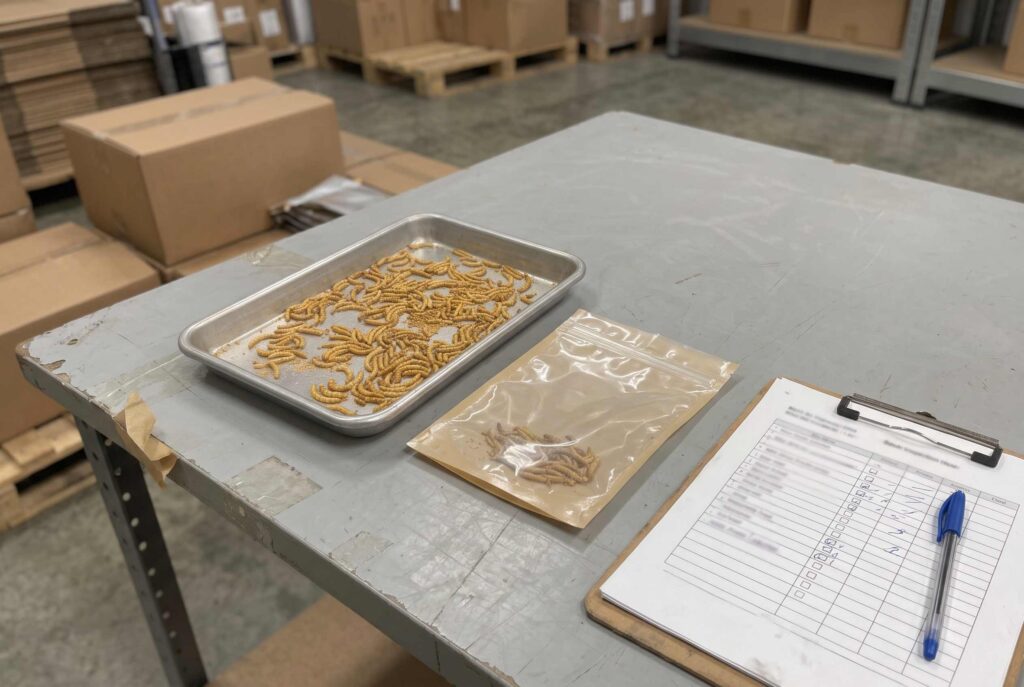
A representative pre-shipment sample provides an initial reference for product appearance, size distribution, dryness, and visible breakage. However, one sample does not establish that every carton in a commercial shipment will have exactly the same physical condition.
Buyers can request photographs of the actual batch, inspection records, packaging information, and relevant laboratory reports. A Certificate of Analysis (COA) may document parameters such as moisture or other tested characteristics, but it should not be assumed to certify the breakage rate unless physical integrity was explicitly included in the inspection scope.
Batch identification is important because it helps connect the sample, inspection results, packaging records, and shipment documentation. Where physical integrity is a critical purchasing requirement, the contract or purchase order should define the inspection method, acceptance threshold, and process for resolving disputed results.
Packaging also deserves attention. Carton dimensions, inner bags, net weight, palletization, and handling conditions can influence the amount of damage occurring after inspection. A satisfactory pre-shipment sample cannot eliminate the possibility of additional breakage during international transportation.
5. Practical Considerations Before Placing a Bulk Order
Before requesting a final quotation, buyers should explain how the whole dried insects will be used and whether intact appearance is commercially important. A distributor selling visible whole insects may require different physical-integrity standards from a feed manufacturer using the product as an ingredient.
The RFQ should identify the insect species, drying method if relevant, approximate order quantity, preferred packaging, destination, and required acceptance criteria. Where breakage is important, buyers should request a representative sample and agree on a measurable method instead of relying on descriptions such as “premium whole insects” or “very low breakage.”
Buyers should also clarify whether acceptance is based on pre-shipment inspection, destination inspection, or both. The agreed procedure should address sampling, documentation, inspection timing, notification of nonconformity, and appropriate remedies.
A practical approach is to approve a reference sample, establish written tolerances, and confirm how subsequent batches will be evaluated against those requirements. This reduces ambiguity and makes recurring commercial orders easier to manage.
Frequently Asked Questions
Does “whole dried insects” mean 100% intact insects?
Not necessarily. The term describes the intended whole-insect product form rather than an automatic guarantee that every specimen is undamaged. Any required intact percentage or maximum breakage allowance should be specified in the purchasing agreement.
Is there a standard acceptable breakage percentage?
There is no single universal percentage suitable for every species, supplier, and commercial application. Buyers and suppliers should agree on a measurable limit and inspection method appropriate to the product.
Does a higher breakage rate mean lower protein content?
Not automatically. Physical breakage does not by itself demonstrate a change in protein concentration. Nutritional differences should be evaluated using appropriate laboratory data, while breakage should be assessed as a separate physical-quality characteristic.
Can a COA confirm the percentage of broken insects?
Only if the relevant physical-integrity test or inspection result is included in the document or accompanying records, a COA reporting moisture, protein, or microbiological results should not be interpreted as evidence of a particular breakage percentage.
How can buyers reduce breakage during shipping?
Appropriate packaging, reasonable carton loading, secure palletization, and careful handling may help limit damage. The most suitable arrangement depends on the insect species, product fragility, shipment quantity, and transportation conditions.
Conclusion: Set Clear Acceptance Standards Before Ordering
For commercial buyers, the distinction between whole dried insects and broken insects should be based on product form, intended application, and agreed inspection criteria—not appearance alone. A useful specification defines what counts as broken material, how it is measured, and which level is acceptable for the purchasing program.
Representative samples, batch-linked evidence, and documented packaging requirements can make quality discussions more consistent and reduce disagreements after shipment. These controls are especially valuable for buyers placing recurring orders or supplying customers with specific whole-insect appearance requirements.
Explore our whole dried insect product range or contact BulkInsects with your required species, quantity, destination, packaging, and physical-integrity expectations. We can review available product options and coordinate the relevant sample and batch information for your purchasing evaluation.